One Unknown
The semblance hypothesis has identified multiple lines of indirect evidence supporting the plausibility of the IPL mechanism (see Evidence page). However, no studies have yet investigated inter-neuronal inter-spine interactions with the specific aim to test for the presence of IPLs. In this context, it is worth examining the perisynaptic region for its ionic and electrical properties and the candidate mechanisms that can be tested.
When two cellular membranes are separated by distances of approximately 1–30 nm, hydration forces rapidly diminish beyond the first few nanometers, and membrane interactions become increasingly influenced by van der Waals forces, screened electrostatic fields, membrane fluctuations, and the composition of the intervening extracellular matrix (ECM) [1, 2]. Since the ECM contains highly negatively charged molecules such as sulfated glycosaminoglycans and proteoglycans, the resulting polyelectrolyte matrix can bind substantial amounts of Ca²⁺ and other cations, creating a specialized ionic microenvironment [3, 4]. Within such a perisynaptic microdomain, activity-dependent opening of Ca²⁺-permeable channels on adjacent neuronal membranes may lead to rapid influx of extracellular Ca²⁺ into the neurons. As local free Ca²⁺ levels decrease, ECM-bound Ca²⁺ may dissociate from negatively charged sites to replenish the extracellular pool, thereby dynamically altering the balance between bound and free calcium and increasing the density of uncompensated negative charges within the ECM [3, 4]. These changes may modify local ionic conditions, extracellular conductivity, charge screening, and the propagation of extracellular electric fields, causing the microdomain to function as a dynamically regulated electrochemical compartment in which neuronal activity, calcium buffering, and ECM charge state are continuously coupled [4, 5]. Although direct transfer of depolarization between neighboring membranes across such extracellular gaps has not been experimentally demonstrated, electrostatic and ephaptic interactions are expected to depend strongly on membrane separation and the ionic properties of the intervening ECM, with the strongest interactions predicted at the smallest separations [2, 5].
Evidence indicates that the extracellular space (ECS) of the mammalian neuropil is highly heterogeneous, characterized by a "channels-and-pools" topography and the extracellular space of ≤30 nm separating the membranes are observed [6–8]. High-resolution imaging using high-pressure cryofixation and single-nanotube tracking has demonstrated that while ECS widths are diverse, lowest local intermembrane gaps are of 20 nm [9]. Because dendritic spines are the dominant membrane structures in this environment, their high surface area and packing density necessitate these narrow geometric spacings between them [6]. In this context, it is possible to infer that several abutted spines that are separated by ECS space of ≤30 nm may provide a plausible physical architecture for localized inter-spine interactions. Another finding of note is that the minimum inter-spine distances between adjacent dendritic spines of cortical pyramidal neurons and hippocampal CA1 pyramidal neurons are approximately 0.66 μm and 0.60 μm, respectively, along the dendritic shaft [10]. Moreover, the sister branches on a neuron’s dendritic tree often avoid overlapping [11]. Together, these findings indicate that the abutted spines that are separated by ECS space of ≤30 nm most likely belong to different neurons. A pictorial representation of the scale difference between inter-neuronal and intraneuronal spine spacing is given in Fig. 1.
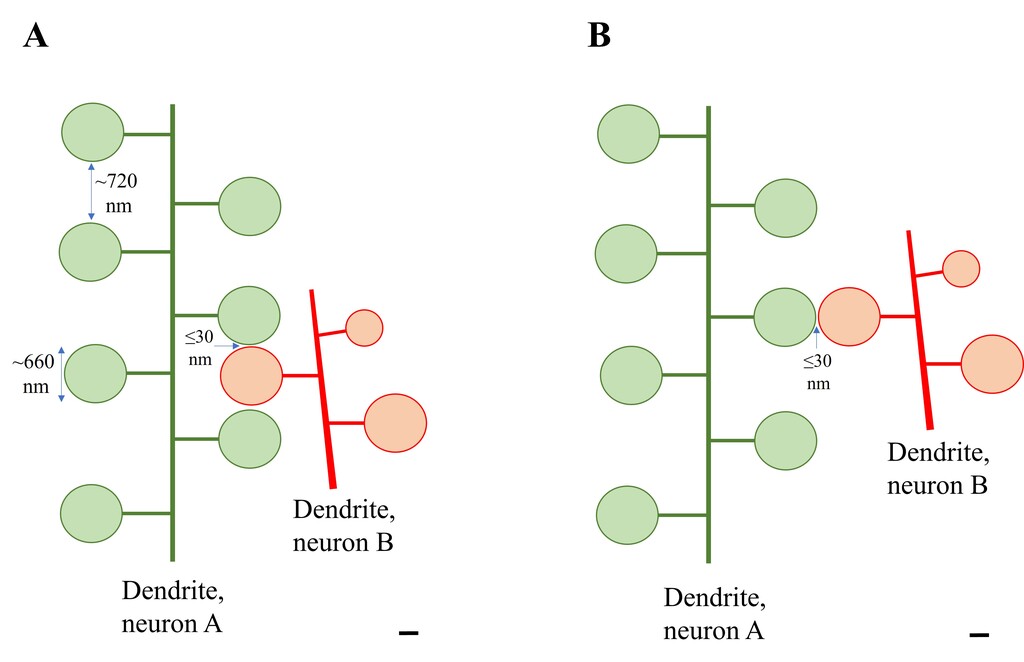
Figure 1. Inter-neuronal and intraneuronal dendritic spine spacing. Because the mean inter-spine distance is greater than the mean spine diameter [10], the space between adjacent spines on a dendritic branch is expected to accommodate a spine from another dendrite, predominantly from a different neuron [11]. Direct spine–spine contacts are likely to be interpreted as artifacts, except in the dendritic excrescences of CA3 pyramidal neurons. Moreover, fixation and the limitations of ultrastructural resolution may preclude the visualization and clear documentation of a continuous range of 0–30 nm separation between spines. A) Because the inter-neuronal separation between adjacent spines can be as small as ≤30 nm, a spine positioned between two spines on a dendritic branch of another neuron could remain without forming an inter-postsynaptic functional LINK (IPL) in the absence of learning. Alternatively, it is plausible that an inter-spine separation of ≤30 nm may facilitate IPL formation, although the precise mechanism or mechanisms underlying such formation remain to be determined. B) An IPL between a spine on one dendrite and a spine on another dendrite could also form between closely apposed or abutted spines outside the inter-spine space. The value of ~720 nm for the inter-spine distance is selected as a convenient value slightly greater than 660 nm, the lowest reported mean inter-spine distance in cortical pyramidal neurons. Scale bar ≈ 200 nm.
The derived IPL mechanism consists of inter-dendritic branch inter-spine interactions between spines, mainly belonging to different neurons. Most likely, it involves a spectrum of mechanisms ranging from charge transfer through yet unknown mechanism, removal of hydration layer between the membranes of abutted spines, reversible partial and complete hemifusion and finally stabilization of complete hemifused membranes. They can be tested as follows.
1. Simultaneous dual-nanopipette recording from abutted dendritic spines in animals [12–14]. Summary: In awake, behaviourally responsive non-human primates or rodents, two flexible quartz nanopipettes (tip diameters 15–30 nm, spring constant ∼0.08 N/m) coated with quantum dots for two-photon visualization can be independently positioned under visual guidance onto two abutted dendritic spines (technically demanding). A gentle touch-and-buzz electroporation protocol can then be applied to each pipette to gain intracellular access to each spine head, enabling simultaneous dual recording from both spines [12, 15, 16]. The prediction is that within a 5–20 ms co-activation window, spontaneous or evoked activity in spine A will produce a subthreshold depolarization in spine B with short, fixed latency. Following recording, distinct fluorescent dyes can be injected through each nanopipette into the respective spine heads and allow to diffuse throughout the parent neuron, after which whole-neuron imaging can be performed to verify if the two spines belong to different neurons. Reproducible transfer significantly above control conditions constitute direct evidence for IPLs; falsification requires its absence across a minimum of 50 confirmed inter-neuronal abutted spine pairs. If recordings suggestive of the presence of IPL are present, extracellular spacing can be transiently increased by focal application of hyperosmotic mannitol-based artificial CSF through a nearby micropipette under two-photon guidance, while neuronal firing rates and membrane excitability are monitored to verify that any change in transfer probability reflects IPL disruption rather than generalized excitability change. The transfer probability and/or amplitude are expected to markedly decrease during extracellular expansion and recovers following washout.
2. Another possible mechanism is localized electrical field that can form between inter-LINKed spines. Given that extracellular potentials can influence nearby neuronal membranes through ephaptic coupling [17, 18], it is possible to infer that such fields could permit highly reversible, rapid voltage transfer between spine heads without persistent structural change. Importantly, biophysical feasibility of field-mediated, non-synaptic interactions in dense cortical neuropil [19], provides indirect support for exploring how IPL-like structures that could operate even if it doesn't directly address or prove the specific IPL mechanism. Endogenous fields (the brain's natural extracellular voltage gradients, Ve) that spans scales (synapses → single neurons → networks) are not mere epiphenomena but can feedback to modulate membrane potentials, synaptic currents, spiking timing, and network synchronization [19].
3. Experimental data suggest that AMPA receptor subunit-containing vesicles with small diameters fuse with spine membrane due to VAMP2 [20]. In addition to delivering AMPA receptor subunit to the postsynaptic membrane [21], this serves another purpose. The vesicles membranes get incorporated with the lateral spine membrane regions of spines to cause regional spine enlargement. The extent of induction of long-term potentiation (LTP) correlates with the ability to learn and can be explained in terms of IPL formation [22]. It is already known that spines expand during LTP induction [23] and that small spines are the preferential sites for cellular changes causing LTP induction [23, 24]. Hence, it is possible to directly examine inter-spine interactions during LTP induction to understand the correlation between the ability to induce LTP and the ability to learn [22].
4. Another testable mechanism involves redox-mediated inter-spine bridging. When spines get abutted more closely (e.g., due to spine expansion by released dopamine [25], redox-active amino acids such as C103 of VAMP2 from two abutted spines can get exposed to the aqueous extracellular medium. When synaptic activity induces local oxygen depletion [26], this along with the release of metal ions like Zn2+ into the extrasynaptic space [27], can facilitate the formation of metal complexes [28] that bridge the spines and facilitate voltage transfer. This is testable.
5. Converging evidence indicates that activity-dependent postsynaptic membrane fusion [29] may prepare abutted spines for hemifusion. This reversible, but potentially stabilizable, stage represents the extreme structural state of IPL formation, the upper limit of a plausible IPL configuration (see Fig. 6 of the Solution page). A typical location for hemifused spines is the dendritic excrescences seen on the dendrites of CA3 pyramidal neurons. This needs to be experimentally verified. Syntaxin-3 (Stx3), a key component of the postsynaptic fusion, where intracellular vesicles containing different components such as AMPA receptor subunits fuse with the spine membrane. Deletion of Stx3 selectively impairs learning-dependent hippocampal computations. The incorporation of vesicular membrane into the plasma membrane exposes newly inserted membrane segment to the extracellular matrix, increasing membrane surface area and altering local membrane curvature, tension, and lipid organization. When these changes occur simultaneously in two abutted spines, they are expected to facilitate the close membrane apposition necessary for IPL formation. In a related experiment, it was shown that injection of inhibitors of membrane fusion into the postsynaptic cell reduce LTP [30].
6. Postsynaptic SNARE proteins are essential for activity-dependent membrane remodeling at dendritic spine margins [30], affecting membrane tension, curvature, and lipid organization, and bringing abutted spines closer together. SNARE proteins overcome curvature-induced energy barriers, thereby initiating hemifusion [31]. SNAREs also generate force to tightly appose membranes [32], forming characteristic hemifusion intermediates [33]. SNARE-mediated fusion of AMPA receptor-containing vesicles with the spine membrane [34] potentially contributes membrane material to lateral spine regions. Based on the semblance hypothesis, SNARE proteins contribute a key role in IPL formation during LTP induction by repurposing fusion machinery to facilitate inter-spine interactions [22]. During heightened synaptic activity, this may allow for transient hemifusion or restricted membrane continuity between abutted postsynaptic membranes, that stops short of full fusion.
7. The finding that ephaptic coupling can account for variability in neural activity [35] provides a potentially valuable framework for testing predictions of the semblance hypothesis. Specifically, if IPL formation and reactivation contribute vector components of extracellular current flow (responsible for oscillating extracellular potentials), these should influence local ephaptic interactions in ways that may be experimentally distinguishable from those produced by conventional synaptic transmission alone.
References
[1] Rand RP, Parsegian VA. Hydration forces between phospholipid bilayers. Biochimica et Biophysica Acta. 1989; 988(3): 351–376. https://doi.org/10.1016/0304-4157(89)90010-5
[2] McIntosh TJ, Simon SA. Roles of bilayer material properties in function and distribution of membrane proteins. Annual Review of Biophysics and Biomolecular Structure. 2006; 35: 177–198. https://doi.org/10.1146/annurev.biophys.35.040405.102022
[3] Ruoslahti E. Brain extracellular matrix. Glycobiology. 1996; 6(5): 489–492. https://doi.org/10.1093/glycob/6.5.489
[4] Dityatev A, Seidenbecher CI, Schachner M. Compartmentalization from the outside: The extracellular matrix and functional microdomains in the brain. Trends in Neurosciences. 2010; 33(11): 503–512. https://doi.org/10.1016/j.tins.2010.08.003
[5] Syková E, Nicholson C. Diffusion in brain extracellular space. Physiological Reviews. 2008; 88(4): 1277–1340. https://doi.org/10.1152/physrev.00027.2007
[6] Kinney JP, Spacek J, Bartol TM, Bajaj CL, Harris KM, Sejnowski TJ. Extracellular sheets and tunnels modulate glutamate diffusion in hippocampal neuropil. The Journal of Comparative Neurology. 2013; 521(2): 448–464. https://doi.org/10.1002/cne.23181
[7] Thorne RG, Nicholson C. In vivo diffusion analysis with quantum dots and dextrans predicts the width of brain extracellular space. Proceedings of the National Academy of Sciences of the United States of America. 2006; 103(14): 5567–5572. https://doi.org/10.1073/pnas.0509425103
[8] Tønnesen J, Hrabĕtová S, Soria FN. Local diffusion in the extracellular space of the brain. Neurobiology of Disease. 2023; 177: 105981. https://doi.org/10.1016/j.nbd.2022.105981
[9] Soria FN, Paviolo C, Doudnikoff E, Arotcarena ML, Lee A, Danné N, Mandal AK, Gosset P, Dehay B, Groc L, Cognet L, Bezard E (2020) Synucleinopathy alters nanoscale organization and diffusion in the brain extracellular space through hyaluronan remodeling. Nat Commun 2020; 11(1): 3440 440 https://doi.org/10.1038/s41467-020-17328-9
[10] Konur S, Rabinowitz D, Fenstermaker VL, Yuste R. Systematic regulation of spine sizes and densities in pyramidal neurons. J Neurobiol. 2003; 56(2): 95-112. https://doi.org/10.1002/neu.10229
[11] Grueber WB, Sagasti A. Self-avoidance and tiling: Mechanisms of dendrite and axon spacing. Cold Spring Harbor Perspectives in Biology. 2010; 2: a001750. https://doi.org/10.1101/cshperspect.a001750
[12] Jayant K, Hirtz JJ, Plante IJ, Tsai D, de Boer WD, Semonche A, Peterka DS, Owen JS, Sahin O, Shepard KL, Yuste R. Targeted intracellular voltage recordings from dendritic spines using quantum-dot-coated nanopipettes. Nat Nanotechnol. 2017; 12(4): 335–342. https://doi.org/10.1038/nnano.2016.268
[13] Jayant K, Wenzel M, Bando Y, Hamm JP, Mandriota N, Rabinowitz JH, Plante IJ, Owen JS, Sahin O, Shepard KL, Yuste R. Flexible nanopipettes for minimally invasive intracellular electrophysiology in vivo. Cell Rep. 2019; 26(1): 266–278.e5. https://doi.org/10.1016/j.celrep.2018.12.019
[14] Koçun C, et al. Nanopipette fabrication for intracellular recording. J Vis Exp. 2012; (66): e3885. https://doi.org/10.3791/3885
[15] Palmer LM, Stuart GJ. Membrane potential changes in dendritic spines during action potentials and synaptic input. J Neurosci. 2009; 29(21): 6897–6904. https://doi.org/10.1523/JNEUROSCI.0758-09.2009 
[16] Tønnesen J, Nägerl UV. Dendritic spines as tunable regulators of synaptic signals. Curr Opin Neurobiol. 2016; 36: 87–92. https://doi.org/10.1016/j.conb.2015.10.011
[17] Anastassiou CA, Perin R, Markram H, Koch C. Ephaptic coupling of cortical neurons. Nature Neuroscience. 2011; 14: 217–223. https://doi.org/10.1038/nn.2727
[18] Fröhlich F, McCormick DA. Endogenous electric fields may guide neocortical network activity. Neuron. 2010; 67: 129–143. https://doi.org/10.1016/j.neuron.2010.06.005
[19] Anastassiou CA, Koch C. Ephaptic coupling to endogenous electric field activity: why bother? Curr Opin Neurobiol. 2015: 95–103. https://doi.org/10.1016/j.conb.2014.09.002
[20] Peters JJ, Leitz J, Oses-Prieto JA, Burlingame AL, Brunger AT. Molecular characterization of AMPA-receptor-containing vesicles. Frontiers in Molecular Neuroscience. 2021; 14: 754631. https://doi.org/10.3389/fnmol.2021.754631
[21] Penn AC, Zhang CL, Georges F, Royer L, Breillat C, Hosy E, et al. Hippocampal LTP and contextual learning require surface diffusion of AMPA receptors. Nature. 2017; 549: 384–388. https://doi.org/10.1038/nature23658
[22] Vadakkan KI. A potential mechanism for first-p rson internal sensation of memory provides evidence for the relationship between learning and LTP induction. Behavioural Brain Research. 2019; 360: 16–35. https://doi.org/10.1016/j.bbr.2018.11.038
[23] Lang C, Barco A, Zablow L, Kandel ER, Siegelbaum SA, Zakharenko SS. Transient expansion of synaptically connected dendritic spines upon induction of hippocampal long-term potentiation. Proc. Natl. Acad. Sci. U.S.A. 2004; 101: 16665–16670, https://doi.org/10.1073/pnas.0407581101
[24] Matsuzaki M, Honkura N, Ellis-Davies GC, Kasai H. Structural basis of long-term potentiation in single dendritic spines. Nature. 2004; 429(6993): 761–766. https://doi.org/10.1038/nature02617
[25] Yagishita S, Hayashi-Takagi A, Ellis-Davies GCR, Urakubo H, Ishii S, Kasai H. A critical time window for dopamine actions on the structural plasticity of dendritic spines. Science. 2014; 345: 1616–1620. https://doi.org/10.1126/science.1255514
[26] Foster KA, Beaver CJ, Turner DA. Interaction between tissue oxygen tension and NADH imaging during synaptic stimulation and hypoxia in rat hippocampal slices. Neuroscience. 2005; 132: 645–657. https://doi.org/10.1016/j.neuroscience.2005.01.040
[27] Bizup B, Tzounopoulos T. On the genesis and unique functions of zinc neuromodulation. Journal of Neurophysiology. 2024; 132: 1241–1254. https://doi.org/10.1152/jn.00285.2024
[28] Go YM, Chandler JD, Jones DP. The cysteine proteome. Free Radical Biology & Medicine. 2015; 84: 227–245. https://doi.org/10.1016/j.freeradbiomed.2015.03.022
[29] Plitt MH., Kaganovsky K, Say E, Sosa M, Südhof TC, Giocomo LM. Hippocampal place code plasticity in CA1 requires postsynaptic membrane fusion. Neuron. 2026; 114: 1473–1488. https://doi.org/10.1016/j.neuron.2026.03.006
[30] Lledo PM, Zhang X, Südhof TC, Malenka RC, Nicoll RA. Postsynaptic membrane fusion and long-term potentiation. Science. 1998; 279: 399–403. https://doi.org/10.1126/science.279.5349.399
[31] Hernandez JM, Stein A, Behrmann E, Riedel D, Cypionka A, Farsi Z, et al. Membrane fusion intermediates via directional and full assembly of the SNARE complex. Science. 2012; 336: 1581–1584. https://doi.org/10.1126/science.1221976
[32] Jahn R, Scheller RH. SNAREs--engines for membrane fusion. Nature Reviews Molecular Cell Biology. 2006; 7: 631–643. https://doi.org/10.1038/nrm2002
[33] Liu T, Wang T, Chapman ER, Weisshaar JC. Productive hemifusion intermediates in fast vesicle fusion driven by neuronal SNAREs. Biophysical Journal. 2008; 94: 1303–1314. https://doi.org/10.1529/biophysj.107.107896
[34] Kennedy MJ, Davison IG, Robinson CG, Ehlers MD. Syntaxin-4 defines a domain for activity-dependent exocytosis in dendritic spines. Cell. 2010; 141: 524–535. https://doi.org/10.1016/j.cell.2010.02.042
[35] Pinotsis DA, Miller EK. Ephaptic coupling can explain variability in neural activity. Cereb Cortex. 2026; 36(6): bhag098. https://doi.org/10.1093/cercor/bhag098